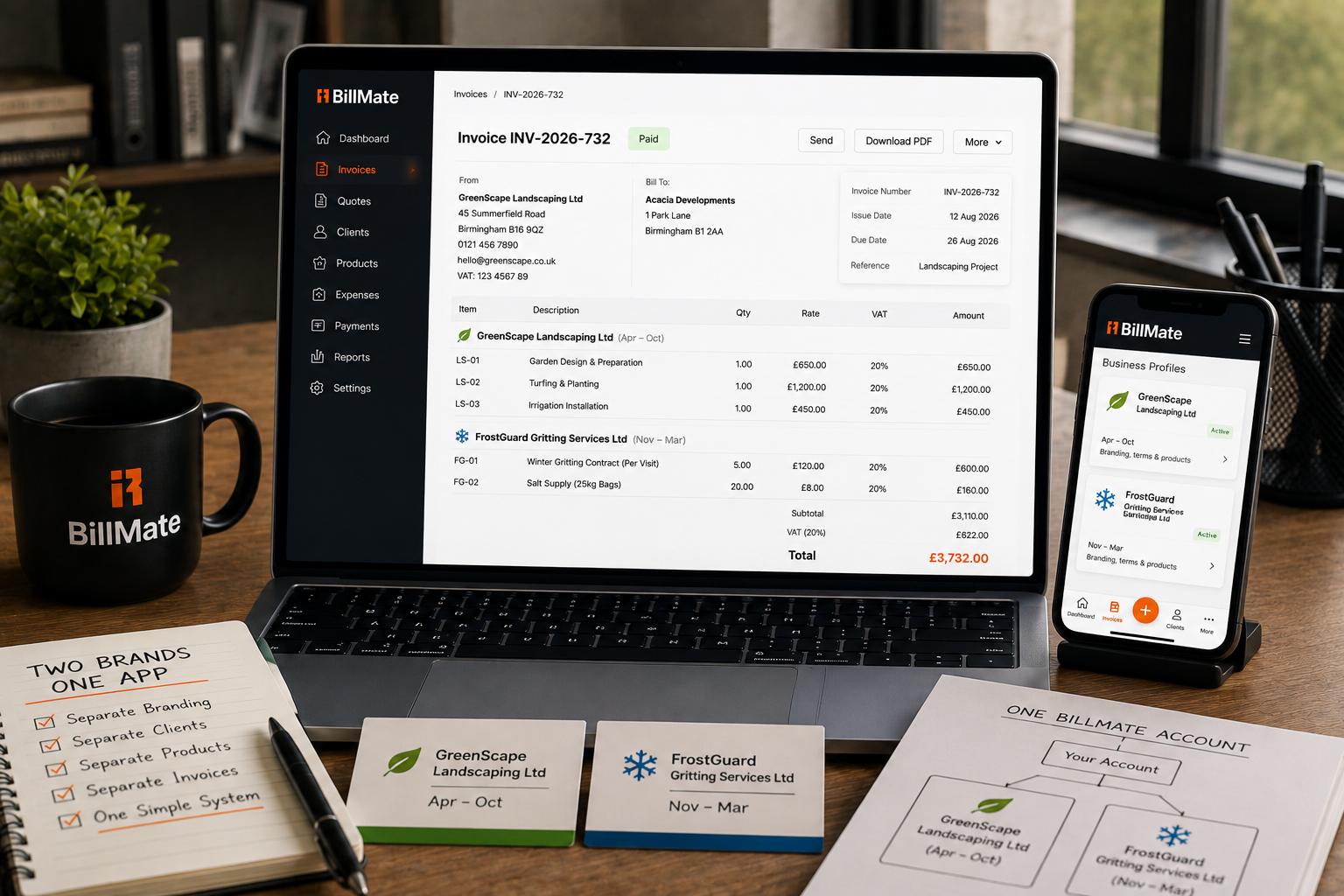
When one arm of a business is VAT-registered and another is not, "keep them separate" cannot rest on nobody ever pasting into the wrong spreadsheet. This Bristol property group made the separation structural — a VAT-registered maintenance company and a management agency running under one BillMate subscription, with books the system will not let mix.
The Challenge
The group runs a VAT-registered maintenance arm alongside a management agency, and the two must stay legally and financially separate. Doing that with spreadsheets meant parallel filing systems, duplicated client records, and a compliance posture that depended entirely on nobody ever pasting into the wrong sheet.
The day-to-day made that fragile. The maintenance team billed from the field while the office issued rent demands, so two very different money flows were being recorded by different people in different places — and then had to be reconciled into a picture that was both correct and cleanly divided. Keeping the streams apart consumed attention that should have gone to running the businesses.
The risk was not hypothetical. A single mis-filed invoice could blur the VAT boundary between the two entities, which is exactly the kind of thing an accountant asks about first.
The Switch To BillMate
BillMate let the group operate both entities under one subscription with genuinely separate business profiles. Different VAT rules apply automatically per profile, and the records never mingle — the boundary is enforced by the system rather than by everyone remembering where it is.
The maintenance team issues invoices on-site through the app; the office team manages rent demands for the agency in the Web App. Same platform, strictly partitioned books, with each arm behaving as its own business where it counts.
How They Use BillMate Day-To-Day
Switching between entities is instant — no logging out, no second set of credentials — but the separation underneath is absolute, which is exactly what the group's accountant wanted to hear. The convenience of one login and the rigour of two separate books are no longer a trade-off.
Auditing became simpler for the same reason. Each business arm produces its own clean trail, so centralised management no longer means commingled records, and preparing for an audit is a matter of exporting what already exists rather than untangling what never should have been mixed.
The Features Doing The Heavy Lifting
Three capabilities carried most of the improvement for this group:
- Separate business profiles under one subscription, with books that never mingle
- Per-profile VAT rules applied automatically to each entity
- On-site app invoicing for maintenance and Web App rent demands for the agency
- Instant switching between entities from a single login
- Clean, separate audit trails for each arm
The same multi-business support would add a third company just as cleanly, each with its own VAT treatment and records.
The Results
The group's priority was compliance, and the results reflect it:
- Strict financial separation between the two entities, enforced structurally
- Different VAT rules applied automatically per profile
- Instant switching between businesses without logging out
- Clean, separate audit trails that made auditing simpler
- An accountant's separation question answered with "structurally", not "carefully"
"Our accountant's first question was how we keep the VAT-registered arm separate. Now the answer is: structurally. The system will not let the two mix."
Group Director, Bristol property group
Advice For Other Property Groups
The group's takeaway was that compliance should be built into the tool, not maintained by hand. If one arm is VAT-registered and another is not, run each as its own profile so the VAT treatment and the records separate themselves, and keep the convenience of a single login for the people who work across both. When separation is structural, the accountant's hardest question becomes the easiest one to answer.
Other multi-entity owners have taken the same route: see how a seasonal entrepreneur runs two brands from one app, or how a creative director kept agency and coaching clients fully segregated.