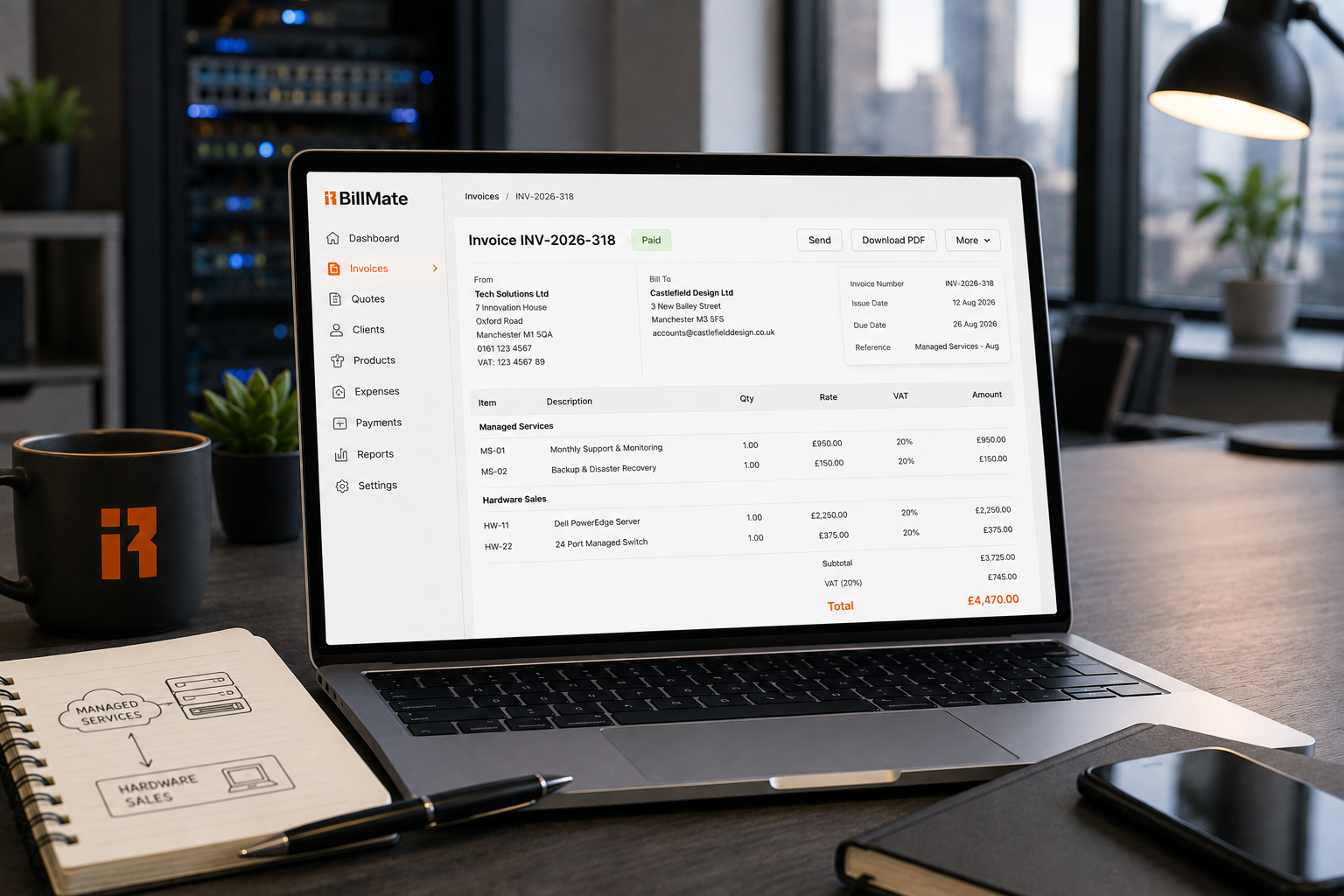
Selling a client a server and supporting it every month are financially opposite transactions — one is high-value with cash at risk, the other is steady recurring revenue. Billing both the same way costs a solo consultant real money. Splitting them into two BillMate profiles with their own terms got hardware paid in a week and, for the first time, showed which half of the business actually pays.
The Challenge
The Manchester consultant ran the whole operation from the same Word documents, which meant the same payment terms for everything and no way to see which side of the business actually made money. A high-value hardware sale and a routine support invoice looked and behaved identically on paper, even though they are nothing alike financially.
Cash flow on hardware was the sharp edge. Fronting the cost of expensive kit and then waiting on the same 30-day terms as a support invoice tied up money that a solo operation feels immediately. Every hardware order effectively became a short-term loan to the client, funded personally.
And because both streams were blended in the same documents, profitability was invisible. The consultant was working hard across two very different activities without knowing which one carried the business.
The Switch To BillMate
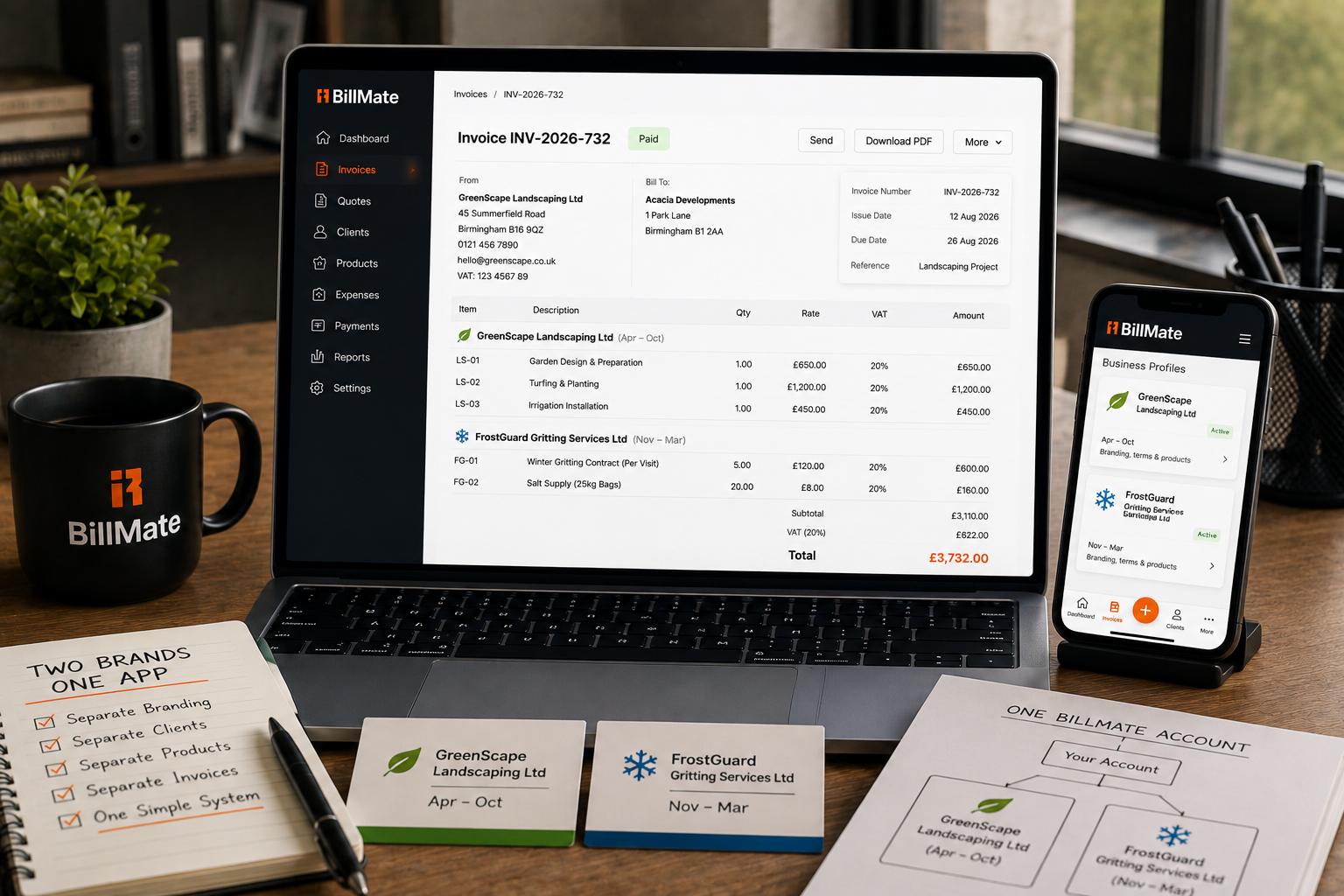
Two BillMate business profiles split the operation cleanly: hardware sales on 7-day terms, managed services on 30-day terms, each with its own presentation. The terms are now a property of the profile, so the right expectation is set on every invoice automatically.
The separation is effortless in practice — a toggle between sales mode and support mode — but complete in the records, which is where it matters. Nothing about day-to-day work got harder; the structure just started doing the thinking.
How They Use BillMate Day-To-Day
Profitability per stream is finally visible. The consultant can see what hardware genuinely returns after costs versus what the support book earns, and plan accordingly — a distinction that, as the quote below admits, did not land the way expected.
Hardware invoices now go out on 7-day terms, so the money that used to sit out for a month comes back in a week, easing the cash-flow squeeze that a solo operation feels most. Support contracts keep their comfortable 30-day terms because there is no reason to rush a recurring relationship.
Corporate clients noticed the change too. Professionally separated paperwork for goods and services reads as an established supplier rather than a one-person band, which has not hurt at renewal time.
The Features Doing The Heavy Lifting
Three capabilities carried most of the improvement for this consultant:
- Separate profiles with their own payment terms — 7-day hardware, 30-day support
- Per-stream profitability tracking that reveals what each side really earns
- A simple toggle between sales and support that keeps records fully separate
- Professional, distinct presentation for goods and for services
The same multi-business support would extend to a third stream just as cleanly under one subscription.
The Results
For a solo consultant, the results were clarity and cash flow:
- Clear profitability tracking per business stream
- Tailored payment terms — 7 days on hardware, 30 days on support
- Hardware money returning in about a week instead of a month
- Professional separation that impressed corporate clients at renewal
- Effortless toggling between sales and support with fully separate records
"Hardware money comes back in a week instead of a month, and I finally know which half of my business earns its keep. Turns out it was not the half I assumed."
IT Consultant, Manchester
Advice For Other IT Consultants And MSPs
The consultant's takeaway was that hardware and services are different businesses and should be billed like it. Put each on its own profile with terms that fit — short on goods you have paid for up front, standard on recurring support — and let per-stream reporting tell you which activity actually funds the other. The cash-flow gain is immediate; the profitability insight is the part that changes what you sell more of.
Other businesses splitting goods from services have taken the same route: see how an events company separated planning fees from equipment hire, or how a seasonal entrepreneur runs two brands from one app.