When a consultancy grows, its invoices tend to grow apart — every team nudging the template until clients receive billing that looks like it came from three different firms. This London consultancy pulled all of that back into one branded invoice standard and, in the same move, turned a three-day month-end close into numbers that are simply there on the dashboard.
The Challenge
The 12-person firm had outgrown its legacy invoicing tool. Templates were generic and awkward to adjust, so different teams had quietly drifted into their own formats — some exporting to Word, some editing PDFs by hand. The invoices reaching clients looked like they came from three separate companies, which is not the impression a consultancy wants to leave at the very end of a piece of paid work.
Finance felt it hardest at month-end. With billing records scattered across the legacy tool and a scatter of ad-hoc documents, closing the month meant manually cross-checking what each team had actually sent. Forecasting was then built on numbers nobody fully trusted, which made cash-flow planning more nervous than it needed to be.
None of this was a headcount problem or a discipline problem. It was a tooling problem: the system could not enforce one way of doing things, so it quietly permitted several.
The Switch To BillMate
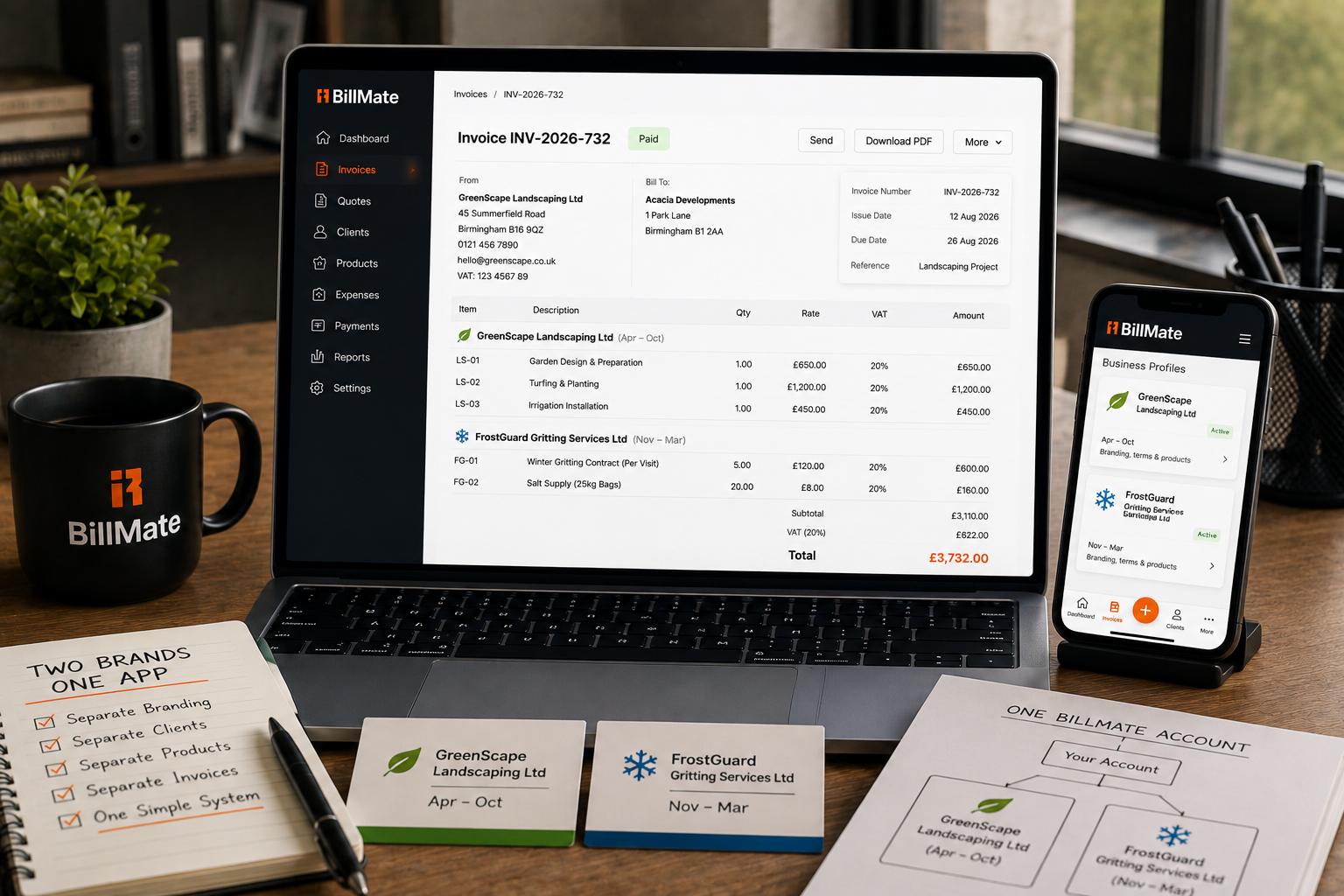
BillMate let the consultancy standardise a single professional invoice template across every team. Branding, payment terms and line-item conventions are set once and applied everywhere, so every invoice that leaves the business looks like it came from the same firm — because it did. The drift simply had nowhere to happen.
Invoices go out by email with consistent branding, and the built-in CRM records client history automatically. Anything entered in the iOS app appears instantly in the Web App, which is where finance lives — so the office and the field are never describing two different versions of the same month.
How They Use BillMate Day-To-Day
Consultants raise invoices from the app straight after client meetings, while finance reviews everything in the Web App with a single unified view of issued, outstanding and paid. There is no export step and no reconciliation between systems, because there is only one system — which is exactly what removed the three-day scramble.
The analytics dashboards turned forecasting from guesswork into a reading exercise: revenue, outstanding amounts and client-level history are live rather than assembled at month-end. Leadership can answer "where are we?" at any point in the month, not just after close.
And for the rare invoice that goes badly overdue, the legal support toolkit is ready without needing a separate process, so chasing a late payer does not become its own project.
The Features Doing The Heavy Lifting
Three capabilities carried most of the improvement for this consultancy:
- One standardised, branded template applied across every team
- A single unified view of issued, outstanding and paid — no reconciliation
- Live analytics dashboards for revenue, outstanding and client history
- Instant iOS-to-Web sync so field and finance share one record
- A built-in legal support toolkit for invoices that go badly overdue
Firms running more than one entity or brand can keep them cleanly separated with multi-business support under a single subscription.
The Results
The consultancy saw the change most clearly at month-end:
- Brand consistency across every invoice and quote
- Month-end close accelerated from roughly three days to same-day, thanks to unified tracking
- Clearer analytics that improved forecasting and cash-flow planning
- A live view of the month rather than a picture assembled after it ended
- A legal support toolkit ready the moment an invoice goes unpaid
"Every invoice finally looks like us. Close used to take three days of chasing spreadsheets; now the numbers are simply there when we open the dashboard."
Finance Lead, London consultancy
Advice For Other Consultancies
The firm's takeaway was that brand consistency and a fast close are the same problem wearing two hats: both come from having one system that everyone actually uses. Set the template once so no team can drift, keep issued, outstanding and paid in a single view, and let live dashboards replace the month-end reconstruction. Do that and the invoice stops undermining the brand and finance stops dreading the calendar.
Other professional firms have taken the same route: see how a creative agency made emailed invoices clients actually read, or how a professional services firm sped up client turnaround.